
Ice cream serving temperature: °F, PAC and texture
The serving temperature decides whether the same recipe comes out creamy or hard. The temperature each serving method needs, how it relates to PAC, and a calculator to estimate it for your recipe.
Free for iPhone and iPad (iOS 15.1 or later), with no ads and no sign-up.
What is serving temperature?
It's the temperature at which the ice cream is served and eaten. It isn't always the storage temperature: the same recipe can be creamy at 10 °F (−12 °C) and rock hard at 0 °F (−18 °C).
It sets the hardness
The colder it's served, the more anti-freezing power the recipe needs so it doesn't turn hard.
It affects the texture
Creaminess, how easily it scoops and how it melts all depend on the serving temperature.
It shapes the recipe
PAC, sugars, water and solids are adjusted to how the ice cream will actually be served.
There's no perfect recipe for every temperature: a display-case recipe doesn't behave the same when it's served straight from a freezer at 0 °F.
Temperature by serving method
These are the ranges Ice Cream Mix uses, with the PAC each one needs:
| Serving method | Ice cream | Ice cream PAC | Sorbet | Sorbet PAC |
|---|---|---|---|---|
| From a freezer | 0 to −4 °F−18 to −20 °C | 250–420 | 0 to −4 °F−18 to −20 °C | 290–460 |
| From a display case | 12 to 7 °F−11 to −14 °C | 220–280 | 9 to 3 °F−13 to −16 °C | 300–380 |
| With Pacojet | 18 to 9 °F−8 to −13 °C | 160–280 | 16 to 7 °F−9 to −14 °C | 220–340 |
| With Ninja Creami | 18 to 12 °F−8 to −11 °C | 160–240 | 16 to 10 °F−9 to −12 °C | 220–300 |
| Soft serve | 21 to 18 °F−6 to −8 °C | 190–230 | 21 to 18 °F−6 to −8 °C | 250–300 |
In a display case, PAC is also fine-tuned by profile: Rich, Classic or Light. More in PAC in ice cream.
Every 20 PAC points, 1 °C (1.8 °F)
PAC decides the temperature at which a recipe is just right. As a rule of thumb, every 20 PAC points are worth about 1 °C of serving temperature.
In ice cream, the milk salts also lower the freezing point: Ice Cream Mix adds about 4.4 points for every 1% of MSNF (milk solids non-fat) to estimate the temperature. In a sorbet, with no dairy, only PAC counts.
Example: the display-case vanilla has a PAC of 251 and 9% MSNF. With the milk salts it reaches about 290 points, so it's just right at 10 °F (−12 °C).
| Serving PAC | Just right at |
|---|---|
| 160–180 | 21 °F −6 °C |
| 200–220 | 18 °F −8 °C |
| 240–260 | 14 °F −10 °C |
| 280–300 | 10 °F −12 °C |
| 320–340 | 7 °F −14 °C |
| 360–380 | 3 °F −16 °C |
| 400–420 | 0 °F −18 °C |
| 440–460 | −4 °F −20 °C |
Serving PAC = PAC + the effect of the milk salts (ice cream only).
Three recipes, three temperatures
Recipes from the Ice Cream Master with their serving temperature calculated by the app:
10 °F (−12 °C) · Vanilla, Classic
PAC 251 and 9% MSNF: about 290 serving points.
14 °F (−10 °C) · Vanilla for Pacojet
PAC 206: less anti-freezing power, because it's served warmer.
5 °F (−15 °C) · Strawberry, Classic
PAC 340 and no dairy: only PAC counts.
Serving temperature calculator
Enter your recipe's PAC (with lactose included) and, for an ice cream, its percentage of milk solids non-fat (MSNF):
It's just right at that temperature: fits a display case.
Rule: every 20 serving PAC points, 1 °C (1.8 °F). For ice cream, add about 4.4 points per 1% of MSNF. It's a working estimate, not a measurement. Use the PAC on the standard scale, where dairy counts through its lactose: that's the one Ice Cream Mix calculates.
Why ice cream is hard in the freezer
Formulating for a display case and then serving from a freezer at 0 °F is the most common mistake.
A recipe that isn't adapted
A recipe designed for 10 °F (−12 °C) is hard at 0 °F (−18 °C): it's 10 °F (6 °C) colder than planned and is missing more than 100 PAC points.
Not enough PAC
To scoop the example vanilla at 0 °F, it would need a PAC of about 365, compared with the 251 it has for a display case.
Too much free water
With too much water, the mix freezes harder and with more ice crystals.
Too few solids
Without enough structure, the ice cream loses body, texture and stability.
If the ice cream comes out hard, adding sugar isn't enough: change the serving method in the app and adjust the sugars that add the most PAC, like dextrose.
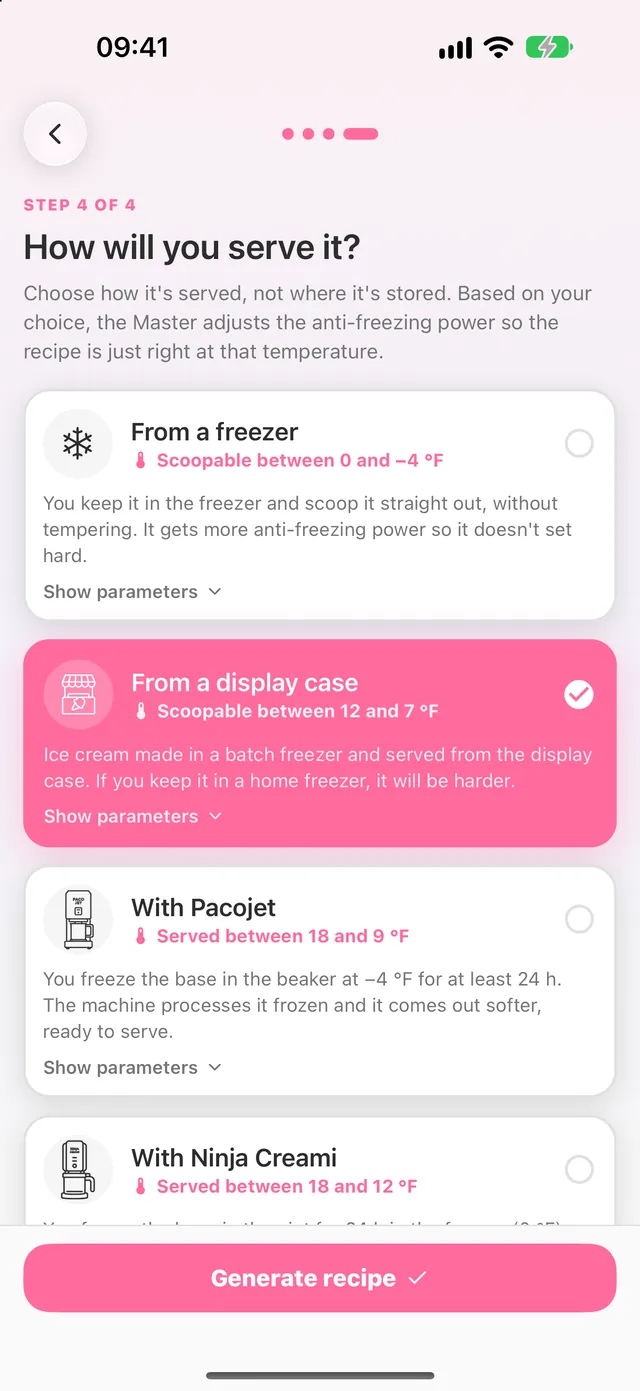
Formulate for the real temperature
In Ice Cream Mix every recipe is formulated for how you'll serve it.
- Choose the serving method: freezer, display case, Pacojet, Ninja Creami or soft serve.
- Check the recipe's estimated serving temperature, in °F or °C, recalculated with every gram.
- Adjust with the Master: if the temperature drifts, it suggests which sugar to change.
Temperature in ice cream and sorbet
Dairy ice cream
Fat and milk solids help the creaminess, and the milk salts lower the serving temperature a little. Even so, PAC still rules the hardness.
Sorbet
With more water and no fat, sorbets need more PAC and closer control of fruit, water and solids. In a display case they're served at 9 to 3 °F (−13 to −16 °C).
Mistakes when adjusting temperature and texture
Using one recipe for everything
A display-case recipe doesn't work the same from a freezer or in a soft-serve machine.
Adding sugar without checking POD
It softens, but leaves the ice cream too sweet. Swapping sugars works better than adding more.
Not measuring the real temperature
What the equipment shows isn't always the product's temperature. Check it with a probe thermometer.
Not adapting sorbets
Water and fruit shape their texture: they need their own PAC range.
Related guides
Frequently asked questions
What is the ideal temperature to serve ice cream?
It depends on how it's served. Ice Cream Mix works with these ranges for ice cream: 12 to 7 °F (−11 to −14 °C) in a display case, 0 to −4 °F (−18 to −20 °C) from a freezer, 18 to 9 °F (−8 to −13 °C) with Pacojet, 18 to 12 °F (−8 to −11 °C) with Ninja Creami and 21 to 18 °F (−6 to −8 °C) for soft serve. A sorbet in a display case is served a little colder, at 9 to 3 °F (−13 to −16 °C).
Why is my ice cream hard at 0 °F?
Probably because it's formulated for a display case. A vanilla with a PAC of 251 is just right at 10 °F (−12 °C); to scoop it at 0 °F (−18 °C) straight from a freezer it would need a PAC of about 365. Choose “From a freezer” as the serving method and adjust the sugars.
How are PAC and serving temperature related?
The more PAC, the colder a recipe can be served without turning hard: every 20 PAC points are worth roughly 1 °C (1.8 °F). In ice cream, the milk salts also help, about 4.4 points for every 1% of milk solids non-fat (MSNF).
Is serving temperature the same as storage temperature?
No. Storage temperature is that of the freezer or cold room (0 °F / −18 °C or colder); serving temperature is the ice cream's temperature when it's served. A display-case ice cream is stored cold and then tempered; one served straight from the freezer needs more PAC.
Is sorbet served at the same temperature as ice cream?
In a display case, a little colder: 9 to 3 °F (−13 to −16 °C), compared with 12 to 7 °F for ice cream. With no milk fat, sorbet needs more PAC (300–380 in a display case) to stay creamy.
Does Ice Cream Mix calculate the serving temperature?
Yes. Every recipe shows its estimated serving temperature, in °F or °C, and compares it with the serving method you choose. If it drifts, the Ice Cream Master suggests which sugar to change.
Match the texture to the real temperature
Ice Cream Mix formulates every recipe for how you'll serve it and tells you the temperature at which it's just right. Free, with no ads and no sign-up.