
Ice cream overrun: what it is and how to calculate it
Overrun is the air the ice cream takes in while it churns. It affects the texture, the lightness, the volume and the yield. What it is, how to measure it, and a calculator to work it out in seconds.
Free for iPhone and iPad (iOS 15.1 or later), with no ads and no sign-up.
Overrun calculator
Fill a cup to the brim with the liquid mix and weigh it. Do the same with the freshly churned ice cream, in the same cup. Enter both weights without the cup, in grams or ounces:
You've incorporated 33% air into your mix.
10 of mix make about 13.3 of ice cream, in the same unit (quarts, gallons or liters).
Overrun % = (weight of the mix − weight of the ice cream) / weight of the ice cream × 100
What is overrun in ice cream?
The air the mix takes in during churning. That air increases the final volume and changes the texture.
Air incorporated
It measures how much air goes into the ice cream as it churns.
Texture and lightness
The right overrun makes the ice cream feel lighter, creamier and more pleasant.
Yield
As air comes in, the volume goes up: it changes how many servings you get from each batch.
The goal isn't the highest possible overrun, but the right one for the type of ice cream, the machine and the way it's served.
Low overrun or high overrun
Air isn't an ingredient, but it changes a lot how the ice cream feels in the mouth.
Low overrun
A denser ice cream with more weight in the mouth. It can taste more intense, but also heavier, and it yields less per quart.
High overrun
A lighter ice cream with more volume and an airy texture. If it's excessive, it feels like foam and loses flavor.
How to calculate overrun step by step
What matters is always comparing the same volume of mix and of ice cream.
Weigh the mix
Fill a cup or container to the brim with the liquid mix and weigh it, minus the container.
Weigh the ice cream
Fill the same container with freshly churned ice cream, with no gaps, and weigh it the same way.
Calculate
Subtract the two weights and divide by the weight of the ice cream. Multiply by 100.
Repeat
Measure several batches to get a reliable reference for each recipe.
| Example with 1 liter | Value |
|---|---|
| Weight of 1 L of mix | 1,000 g |
| Weight of 1 L of ice cream | 750 g |
| Overrun | (1,000 − 750) / 750 = 33% |
| Yield | 1 L of mix → 1.33 L of ice cream |
Air takes up volume but has no weight: that's why a quart of ice cream weighs less than a quart of mix.
Reference overrun ranges
They vary with the machine, the recipe, the fat, the solids and the stabilizer:
| Type of product | Overrun | Typical result |
|---|---|---|
| Premium artisan ice cream | 20–40% | Dense, creamy texture with lots of flavor. |
| Display-case ice cream | 30–50% | A balance of lightness, service and yield. |
| Soft serve | 40–70% | Light, airy and smooth texture. |
| Industrial ice cream | Can be higher | More air and more final volume. |
How to control overrun
It doesn't depend only on the machine, but also on the recipe and the process.
Formulate a balanced base
With solids, fat, stabilizer and water well adjusted, the mix holds air better.
Let it age
Resting cold hydrates the stabilizer and improves how the mix behaves when churned.
Watch the inlet temperature
A mix that isn't cold enough whips worse and forms bigger crystals.
Always measure the same volume
Compare the weight of the same container of mix and of ice cream.
Judge texture and yield
Don't stop at the number: look at creaminess, lightness, melting and volume.
What affects overrun
Fat
It shapes the structure, the emulsion and the creaminess, and helps stabilize the air.
Total solids
They give body and help the mix hold on to the air.
Stabilizer
It makes the incorporated air stronger and more stable.
Type of machine
A batch freezer, a soft-serve machine and a home machine don't incorporate air the same way.
Mistakes when measuring overrun
Comparing different volumes
For the calculation to work, weigh exactly the same volume of mix and of ice cream.
Confusing volume with quality
More volume isn't always better ice cream: too much air takes away intensity.
Not linking it to the recipe
Read overrun together with fat, solids, water, stabilizer, PAC and POD.
Measuring only once
Measure several batches to get a reliable figure for each recipe.
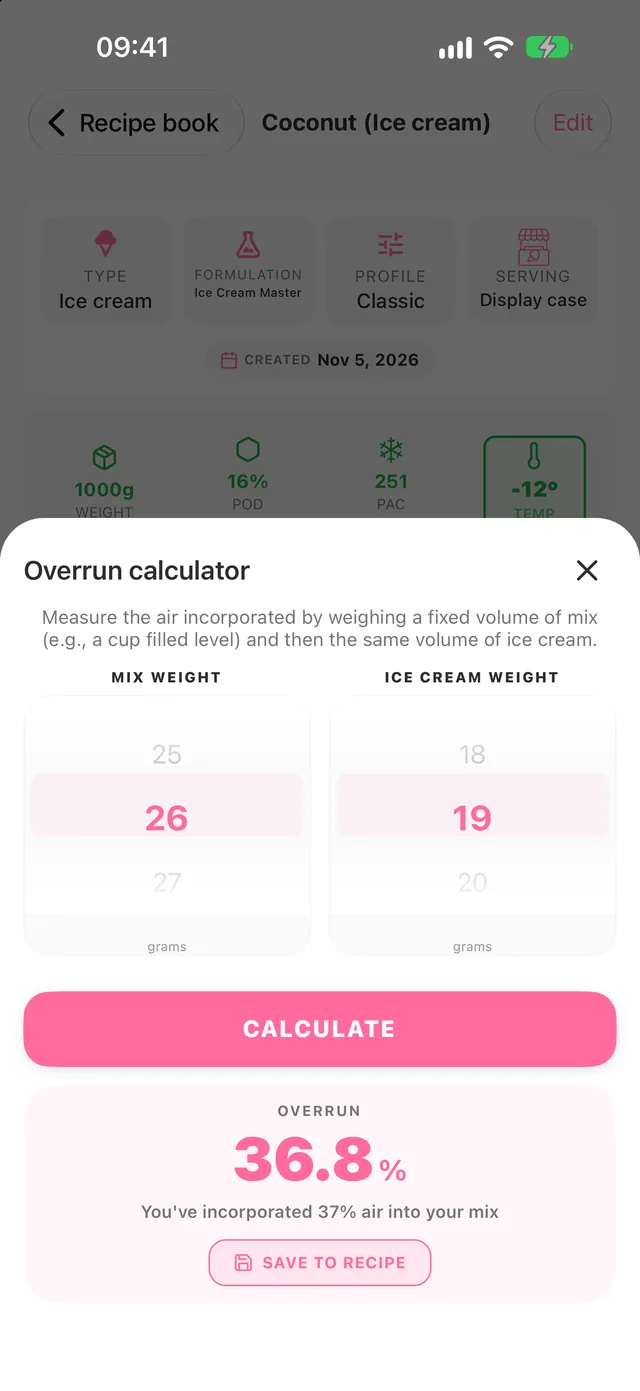
Overrun, on every recipe page
Ice Cream Mix includes an overrun calculator on every recipe.
- Enter the weight of the mix and of the ice cream, and save the result to the recipe.
- Every recipe keeps its overrun history by batch.
- Scale the formula to the batch you're making and follow each stage with a timer.
- Read overrun together with the recipe's PAC, POD, solids and water.
Related guides
Frequently asked questions
What is overrun in ice cream?
The percentage of air the mix takes in while it churns. It increases the volume and changes the texture, the lightness, the yield and how creamy it feels.
How do you calculate overrun?
Weigh the same volume of mix and of finished ice cream, for example a cup filled to the brim. Overrun % = (weight of the mix − weight of the ice cream) / weight of the ice cream × 100. If 1 liter of mix weighs 1,000 g and 1 liter of ice cream weighs 750 g, the overrun is 33%.
Is a higher overrun better?
Not always. More air gives more volume, but too much overrun makes the ice cream feel foamy, overly light and less flavorful.
What overrun is ideal for artisan ice cream?
It depends on the style: a premium artisan ice cream usually lands between 20 and 40%, a display-case ice cream between 30 and 50% and soft serve between 40 and 70%.
Does overrun affect the yield?
Yes. The volume of ice cream is the volume of mix multiplied by (1 + overrun): with 30% overrun, 10 quarts of mix make about 13 quarts of ice cream.
Does Ice Cream Mix calculate overrun?
Yes. Every recipe has its own overrun calculator: you enter the weight of the mix and of the ice cream, and save the result to the recipe page with its history by batch.
Keep track of your overrun
Ice Cream Mix saves the overrun of every batch on the recipe page, next to PAC, POD, solids and water. Free, with no ads and no sign-up.